
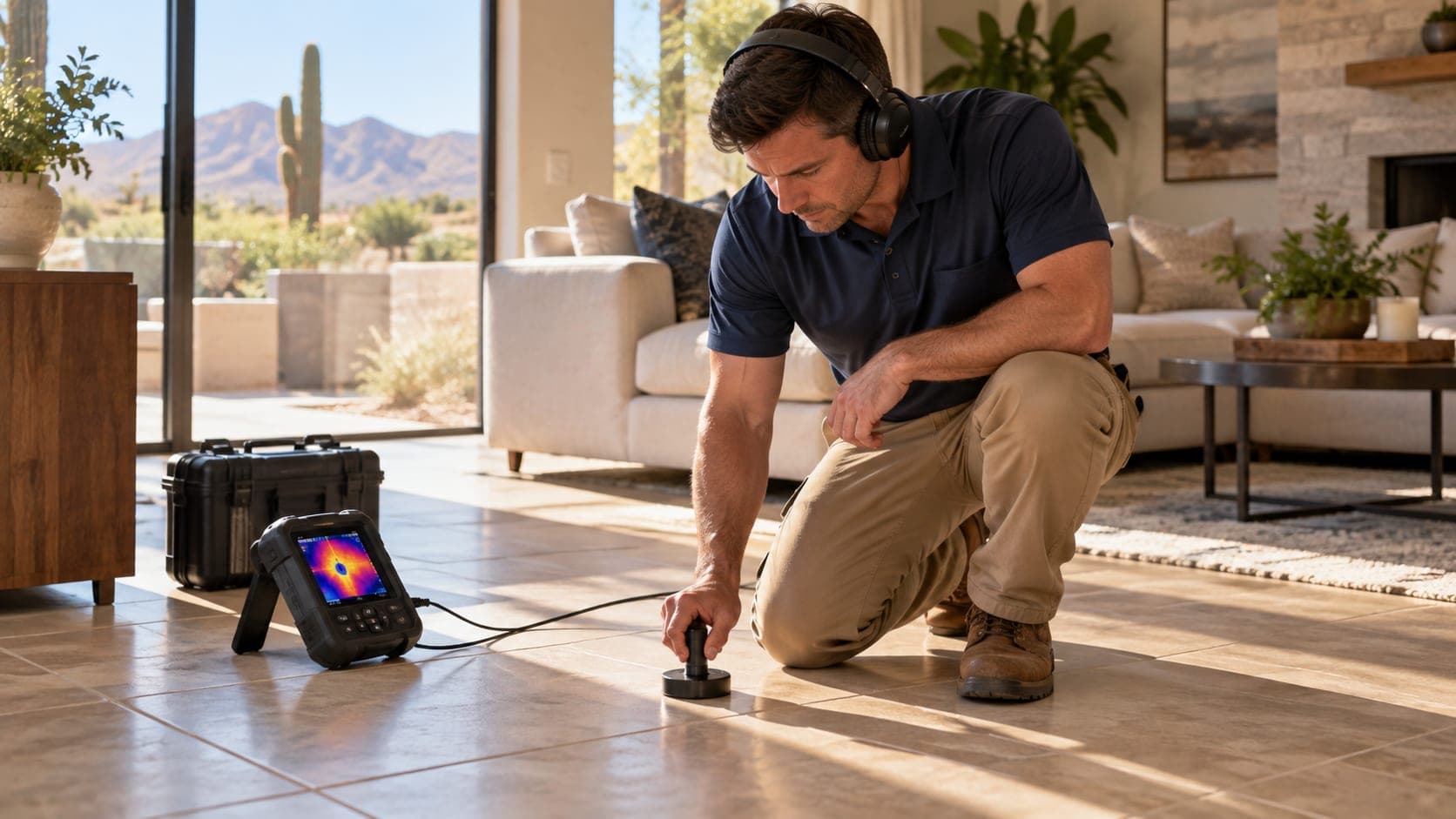
Put your ear to a garden hose with the nozzle closed and a pinhole in the side. You will hear it: a thin, steady hiss, the sound of water forced through an opening too small for its ambition. Now bury that hose a foot deep, pour a slab on top, lay tile, and add a family walking around. The hiss is still there. It has simply gone somewhere your ears cannot follow. Acoustic detection follows it.
How it works
Pressurized water leaving a pipe creates vibration at the leak point. That vibration travels along the pipe wall and outward through the surrounding soil, concrete, and flooring, losing energy as it goes. A ground microphone placed on the surface picks up what remains. Move the sensor along the pipe's route and the signal grows louder as you approach the leak and quieter as you pass it. The peak is the spot.
That is the principle. The practice is harder. Refrigerators hum. Air conditioners cycle. Traffic passes. A skilled technician learns to filter the house from the leak, adjusts the sensor's frequency band to the pipe material and depth, and reads the peak with confidence rather than hope. The instrument is essential. The training is what makes it accurate.
Two tools, one method
Ground microphones
A sensitive contact sensor and headset. We walk the pipe route on the surface and listen for the peak. Best for slabs, floors, and shallow yard lines where we can get directly over the pipe.
Leak correlators
Two sensors placed on the pipe at accessible points, such as a meter and a hose bib. The correlator measures how long the leak sound takes to reach each sensor and calculates the exact distance to the leak. Best for long runs and paved surfaces where walking the line is not possible.
A slab leak is invisible and silent to a homeowner. To the right sensor, it is the loudest thing in the house.
Where acoustic detection earns its keep
- [Slab leaks](/slab-leak-detection). The classic use. Pressurized copper under concrete, located from the tile above.
- [Main water lines](/main-water-line-leak-detection). Long buried runs under yards and driveways, where correlation between the meter and the house does the geometry.
- Irrigation mains. Pressurized landscape lines that leak into soil nobody inspects.
- Pool and spa plumbing. Pressurized return and suction lines around the shell, once the shell itself has been ruled out.
- Commercial site mains. Acres of buried line under parking lots and landscaping.
Where it does not, and what we use instead
Acoustic detection depends on pressure. A leak in a drain line, which flows by gravity, makes almost no sound and is found with a camera instead. Very slow leaks in deep or plastic pipe can be too quiet to hear, which is where thermal imaging and pressure testing close the gap. And an acoustic peak means little without knowing where the pipe runs, so we trace the line electromagnetically first. No single tool finds every leak. That is why we carry all of them.
Why non-invasive is not a marketing word
The alternative to listening is cutting. Before instruments like these were common, locating a slab leak meant opening the floor where the plumber thought the pipe might be, then opening it again where it actually was. Every miss cost a homeowner tile, concrete, and a weekend. Acoustic detection ended that. One hole, at the mark, is the modern standard, and it is the only one we hold ourselves to.
Acoustic questions
Can you hear a leak through tile or concrete?
Yes. The sensors are built for it. Concrete transmits the vibration well; carpet and padding dampen it, so we may lift a corner or listen at fixtures instead.
How accurate is acoustic leak detection?
On a good signal, within a foot or two, and often tighter when correlated with thermal imaging and pipe tracing. We tell you our confidence, not just our mark.
Does it work on plastic pipe?
Plastic transmits sound less well than metal, so the range is shorter and the technique changes. It still works; it just takes more care and often a correlator instead of a ground microphone.
Is it safe for my home?
Completely. Acoustic detection is passive listening. Nothing is injected, energized, or cut.