
Drive Main Street from the Tempe line to the Superstitions and you will pass through every decade of Valley homebuilding in order. The post-war blocks west of Country Club have galvanized supply lines that have narrowed to a pencil and cast-iron drains with the bottoms rusted out. Dobson Ranch and the 1970s lake communities run copper under slab that has been sweating for fifty summers. Red Mountain Ranch and Las Sendas are 90s copper, mostly sound, with the occasional pinhole where the soil moved. Eastmark and the new southeast subdivisions are PEX and will not be calling us for a long while. The same technician sees all four in a week.
Mesa's leaks, by neighborhood
West Mesa and the historic core
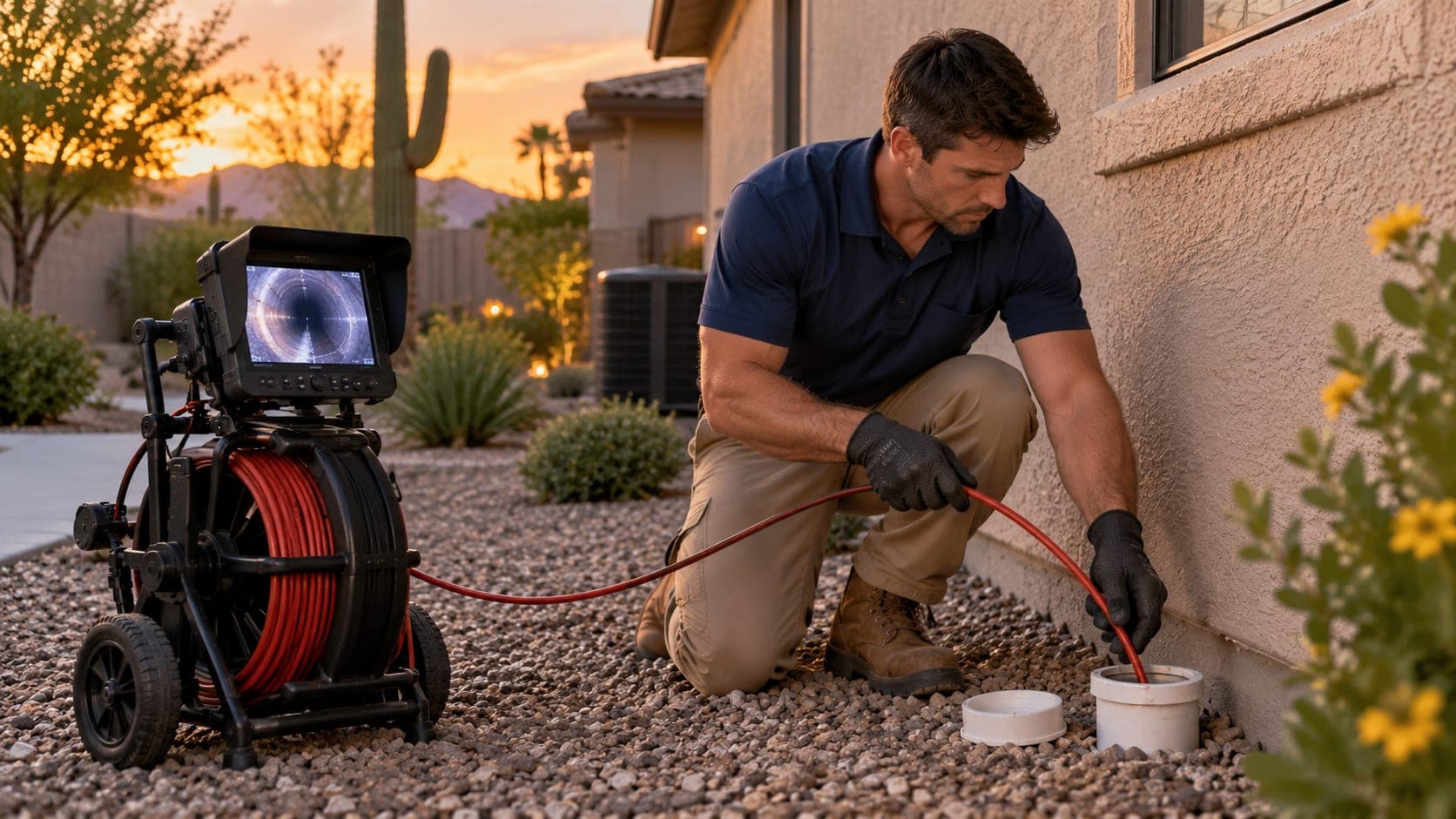
Sewer laterals are the story here. Clay and cast iron, root intrusion from mature trees, and bellies where the ground settled. A camera settles the argument in twenty minutes.
Dobson Ranch and the lake communities
Copper under slab from the 70s and 80s. Hot-water lines fail first. Warm tile and a bill that will not come down are the tells.
Red Mountain and Las Sendas
Hillside lots with pools and long irrigation runs. Leaks travel downhill through fill and show up nowhere near the source.
Southeast Mesa and Eastmark
New pipe, big lots, HOA irrigation. When the bill spikes, it is almost always outside the house. We start at the meter and the controller.
Falcon Field and the industrial corridors
Hangars, shops, and warehouses on old slab with process water. Zone isolation after hours.
Multifamily along the 60 and the light rail
Stacked units, shared risers, a leak on three showing up on one. We isolate by stack and by floor.
Why the ground matters in Mesa
Much of Mesa was citrus and cotton before it was subdivisions, and the old irrigation grid left the soil in layers: silt over clay over hardpan. Clay swells when the monsoon comes and shrinks when it leaves, and a slab sitting on it rides up and down a fraction of an inch each year. Copper does not enjoy the ride. Neither does clay sewer pipe, whose joints open a hair each cycle until a root finds the gap. It is not bad construction. It is fifty years of a floor that will not hold still.
Mesa did not build badly. It built early, on ground that moves, and the pipe has been keeping score ever since.
What a Mesa visit includes
- 1
Meter check
City of Mesa meters carry a leak indicator. House closed, dial watched. Inside or outside, settled in two minutes.
- 2
Pressure isolation
Hot, cold, irrigation, pool. The gauge names the guilty line before we search.
- 3
Camera when the drains say so
Slow drains, a smell, a soft patch in the yard. The camera goes in through the cleanout and the transmitter marks the defect from above.
- 4
Written report
Photos, thermal images, video where a camera was used, and a plumber we trust. Yours before we leave.
Mesa leak detection questions
Do you cover east Mesa out to the Pinal County line?
Yes. Eastmark, Cadence, and the subdivisions along Ellsworth and Signal Butte are on the route, along with Apache Junction next door.
My drains are slow and the yard smells. Is that a leak?
Usually a sewer line defect. A camera inspection finds the break, belly, or root mass, and a transmitter in the camera head lets us mark its exact position and depth on the ground.
Can you tell me if the leak is on the city side?
Yes. Everything up to and including the meter belongs to the City of Mesa. Our first test shows which side is losing, and if it is theirs, we tell you and help you make the call.