
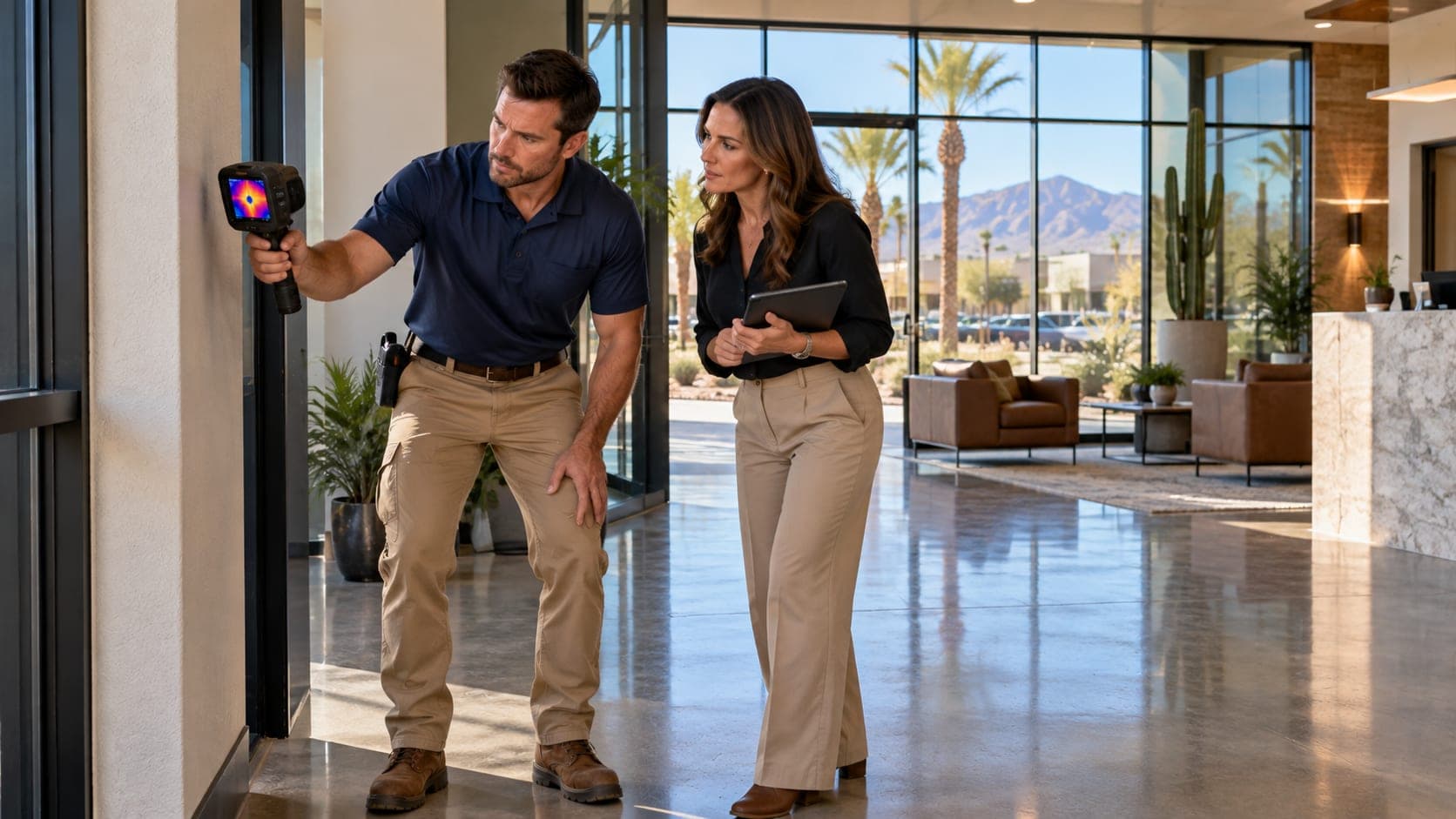
Chandler has two plumbing populations. The old town around Arizona Avenue and the neighborhoods north of the 202 date to the 60s and 70s and carry the same aging copper and galvanized as their neighbors in Mesa and Tempe. Everything south and east, Ocotillo, Fulton Ranch, Cooper Commons, the lake communities, and the long grid of subdivisions toward Queen Creek, was built between 1990 and 2008 in a single sustained rush. That copper is now twenty-five to thirty-five years old, which in Valley soil is precisely the age at which hot-water lines under slab begin to pinhole. Chandler is not falling apart. It is simply arriving at the part of the calendar where the phone starts ringing.
Chandler leaks, by the part of town
The 90s belt: Ocotillo to Cooper Commons
Copper under slab, hot side first. Warm tile, a bill that climbed, the sound of water at night. This is most of our Chandler work.
Lake communities
Ocotillo, Fulton Ranch, and the lakeside HOAs sit on high water tables and engineered fill. Leaks migrate along the fill and surface far from the source. Correlation finds the origin.
Pools, most yards
Chandler's pool density is among the highest in the Valley. Skimmer and return lines under decks fail quietly. Line-by-line pressure tests find which one.
Downtown and the older north side
Sewer laterals and galvanized supply from the 60s and 70s. A camera in the lateral and a gauge on the supply settle it in one visit.
Price Road and the tech corridor
Data centers, fabs, and offices where a shutdown is measured in dollars per minute. Zone isolation scheduled around production, with documentation for facilities and insurers.
HOA irrigation and common areas
Miles of mains feeding turf and lakes. When the association's bill jumps, we trace and listen block by block.
The nineties built Chandler in a hurry. The pipe is only now catching up on the bill.
Why 30-year-old copper fails here
Copper does not rust, but it does erode, and Valley water is abrasive: hard, mineral-heavy, and hot on the supply side for half the year. Inside the pipe, scale builds where the water slows and pits where it speeds up. Outside, the slab's soil, much of it old farmland with clay beneath, swells and shrinks each season and works the pipe against the concrete. The hot line loses first because heat accelerates both the chemistry and the movement. Thirty years is not a defect. It is a lifespan, and Chandler's biggest neighborhoods are reaching it together.
What a Chandler locate includes
- 1
Meter first
City of Chandler meters carry a leak indicator. House closed, dial watched. Yard or house, settled in two minutes.
- 2
Isolate hot, cold, pool, and irrigation
In a lake community with a pool, this step narrows an acre of suspects to one line.
- 3
Listen on the slab
Acoustic sensors along the traced line. Chandler tile carries the sound well.
- 4
Report with options
Spot repair, reroute overhead, or repipe. We lay out the trade-offs plainly; the plumber you choose does the work.
Chandler leak detection questions
Do you serve Sun Lakes and the county islands?
Yes. Sun Lakes, the unincorporated pockets south of Chandler, and the Gilbert and Queen Creek borders are all on the route.
Can you work at a commercial site without stopping production?
Almost always. Pressure isolation by zone during off-hours, acoustic and thermal survey that disturbs nothing, and a report your facilities team can act on the next morning.
Is a reroute really better than a spot repair?
It depends on the pipe. One pinhole in otherwise sound copper is a spot repair. The second or third in the same run is a warning that the whole line is at end of life, and a reroute through the attic avoids the slab entirely.