
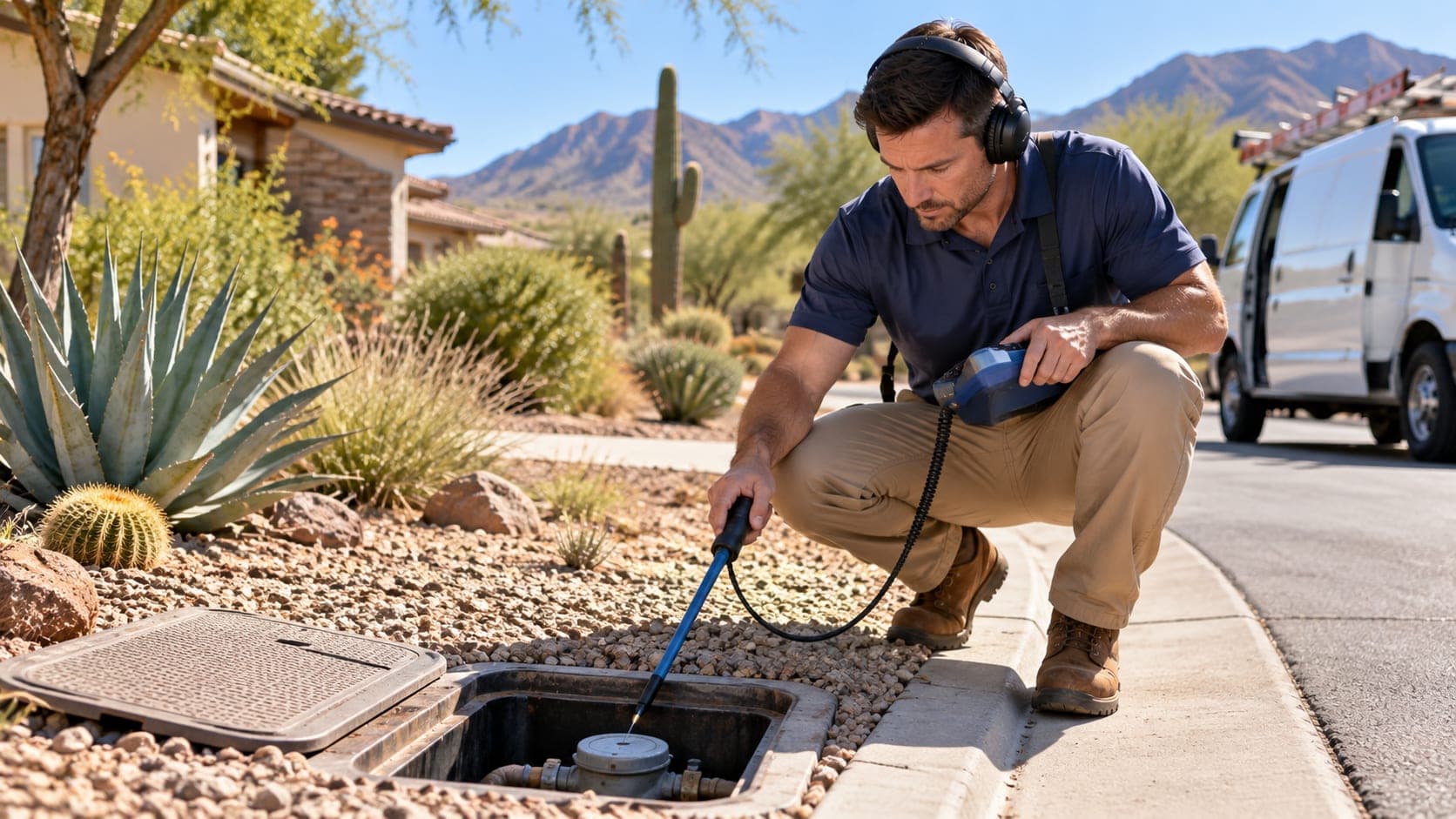
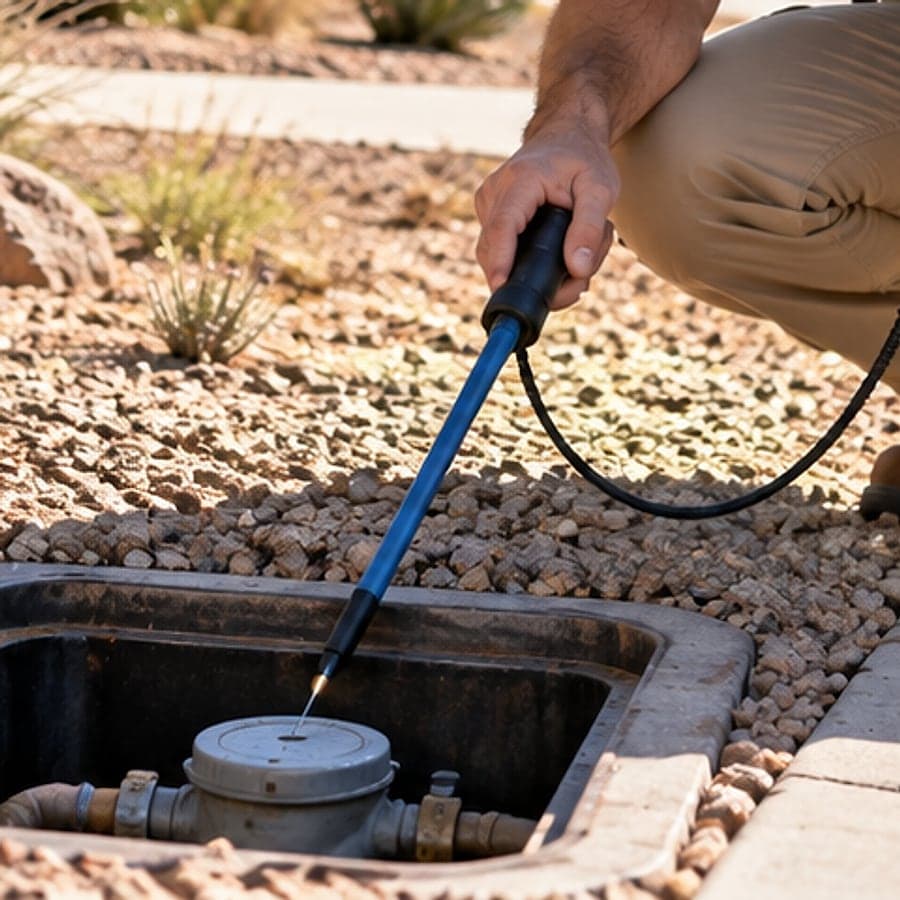
Between the meter box at the curb and the valve at your house lies a length of pipe you have never seen and think about only when it fails. It belongs to you, not the city. The city's responsibility stops at the meter. Yours begins there. That single fact surprises more homeowners than any other in this business, usually while they are holding a water bill with too many digits.
Why main lines fail in Phoenix
Age, first. A service line installed in the 1970s has been through fifty summers of soil movement. Material, second. Galvanized steel rusts from inside. Older polybutylene grows brittle. Copper pinholes where the soil is aggressive. Trees, third. Roots follow moisture and will find a weeping joint, then pry it open. And the desert itself: expansive clay swells with the monsoon and shrinks in the dry season, tugging on anything buried in it. Add a driveway poured over the line and a decade of cars, and failure is not a question of if.
The signs of a main line leak
The bill climbed, the habits did not
Main line leaks run continuously at full pressure. They show on the bill before anywhere else, because there is nowhere else for the water to show.
Lower pressure throughout the house
A leak before the house steals pressure from every fixture at once. Weak showers and slow-filling toilets on every floor point upstream.
Wet or soft spots in the yard
Puddles that do not match the sprinkler schedule. A patch of grass greener than its neighbors. Ground that gives underfoot in a city that gets eight inches of rain a year.
The meter turns with everything off
Close every fixture. Watch the small dial. If it moves, water is leaving the system between the meter and your faucets.
Running water you cannot find
A hiss at the point where the line enters the house, or at the meter box, with no fixture open.
Sinking or cracked pavement
Water washes out the base under a driveway or walk. The concrete follows.
The city's pipe ends at the meter. Yours begins there. The leak is almost always on your side, and so is the bill.
How we locate a main line leak
- 1
Confirm at the meter
We isolate the house from the service line and watch the meter. If it turns with the house valve closed, the leak is in the buried line. If it stops, the leak is inside.
- 2
Trace the line
Most homeowners do not know where the line runs. We do not guess. Electromagnetic locating and ground-penetrating radar map the pipe's route and depth before we listen.
- 3
Listen and correlate
Acoustic sensors along the traced route hear pressurized water escaping through soil. The signal peaks over the break. Where the surface is paved, correlation between two sensors does the math.
- 4
Mark and measure
Paint or a flag on the surface, with depth noted. The plumber digs one hole at our mark instead of trenching the yard hunting for it.
- 5
Report and refer
Photos, a sketch, the pipe material we found, and the repair options: spot repair or full line replacement. We refer plumbers we trust for either.
Repair or replace?
A single break in an otherwise sound line is a spot repair. A break in galvanized steel or polybutylene that has already failed once is a warning: the next break is scheduled, you just do not know the date. In those cases, a full replacement, often by trenchless methods that avoid tearing out the driveway, is usually the cheaper choice over five years. We show you what we found and what it means. The decision stays yours.
Main line questions
How do I know if the leak is inside or outside the house?
Close the main shutoff valve at the house and watch the meter. If the meter still turns, the leak is in the buried line between meter and house. If it stops, the leak is inside. We do this test first and tell you the result on the spot.
Will you have to dig up my yard to find it?
No. We locate from the surface with tracing equipment and acoustic sensors. Digging is for the repair, and it is one hole at our mark.
Can you find a leak under a driveway or slab?
Yes. Acoustic correlation works through concrete and asphalt. It is the standard method for paved surfaces.
How much does a main line leak waste?
A lot. These lines run at full street pressure, continuously, with nothing to slow them. Hundreds of gallons a day is common. The bill is the honest witness.