
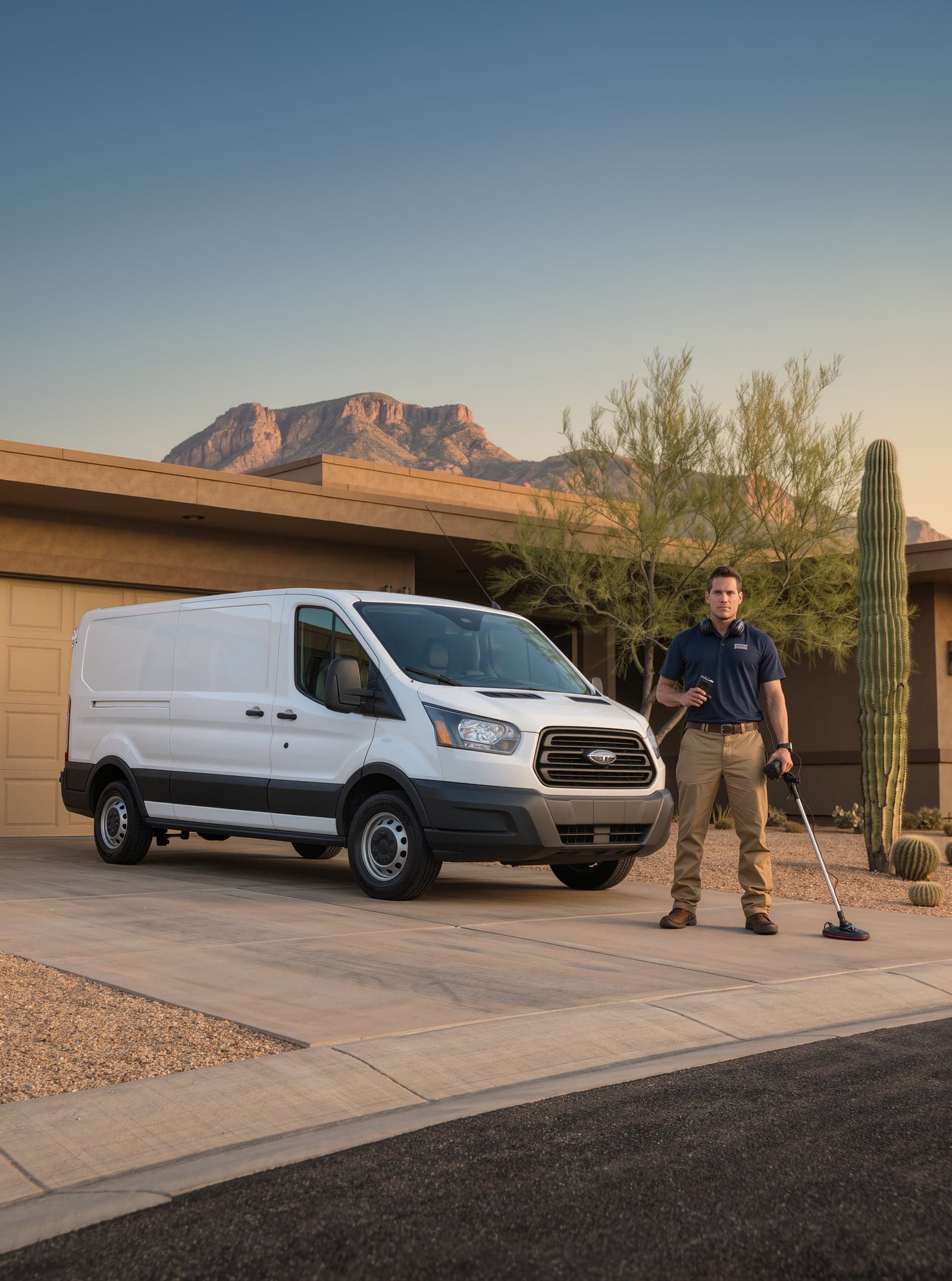
Fountain Hills was laid out in 1970 on the far side of the McDowells, a master plan draped over hills that were never going to be flat. The houses came in waves: 70s and 80s copper under slab on the terraced lots near the lake, 90s and 2000s construction climbing higher, custom homes on the ridges with views to the Four Peaks. All of it sits on cut granite and imported fill, and all of it slopes. Water that escapes a pipe on a Fountain Hills lot does not pool around the break. It follows the rock downhill, sometimes under a neighbor's wall, and surfaces wherever gravity lets it. The first thing we tell homeowners here is to stop digging at the wet spot.
Where Fountain Hills leaks
70s and 80s copper near the lake and Fountain Park
The town's original neighborhoods, now fifty years into slab copper. Hot lines first. Warm tile, a bill that will not come down.
Terraced and hillside lots
Leaks travel along the rock face and surface downhill. Correlation finds the origin, which is often far uphill of the damp patch.
Service lines through cut rock
Trenched through granite wherever the builder could, decades ago, with no surviving drawing. We trace the real route before we listen.
Pools on retaining walls
Decks cantilevered over fill. Return and skimmer lines under them, tested one at a time so the deck is opened once.
HOA and common-area mains
Long runs under desert landscaping and medians on the association's bill.
The Avenue and the town center
Restaurants and retail on commercial slab. After-hours isolation so nothing closes.
On a hillside the wet spot is a rumor. The pipe is the source, and it is usually uphill.
How hillside leaks fool people
Fill behaves like a sponge laid over stone. Water from a broken line saturates the fill, hits the rock beneath, and runs along it until the slope lets it out. A homeowner sees dampness at the base of a retaining wall, a plumber digs there, and the pipe is bone dry. Meanwhile the break is forty feet up the hill under a patio. Acoustic correlation solves this without a shovel: two sensors on the traced line, one above and one below the suspected zone, and the arrival-time difference computes the distance to the leak regardless of where the water chose to appear.
The Fountain Hills visit
- 1
Meter first
Town meters carry a low-flow indicator. House closed, dial watched. Yard or house in two minutes.
- 2
Trace the line down the hill
Electromagnetic locating and radar map the route and depth through fill and rock.
- 3
Correlate
Two sensors, one calculation, one mark. Under pavers, decks, and rock.
- 4
Report with a slope sketch
Photos, position, depth, and a plumber we trust who has worked on this terrain.
Fountain Hills leak detection questions
There is water at my retaining wall and the plumber found dry pipe. What now?
The break is uphill. Water ran along the rock and came out at the wall. We correlate along the traced line to find where it actually left the pipe.
My house is from 1975. Should I expect a slab leak?
Expect that the original copper is at the end of its service life. One leak is a spot repair; a second in the same run is a pattern, and a reroute is usually the better money.
Do you serve Rio Verde and the area past the town limits?
Yes. Rio Verde, Fort McDowell, and the desert parcels between them and Fountain Hills are on the route.