
Paul Litchfield laid out this town for the Goodyear Tire and Rubber Company, planted it with palms, olives, and eucalyptus, and gave the West Valley the one thing the rest of it lacks: shade. A century later the trees are magnificent and the plumbing under them is doing what plumbing under trees does. Roots find the joint in a clay lateral, pry it open a hair each season, and fill the pipe. Meanwhile the mid-century homes around the historic core and the Wigwam run copper under slabs that have seen sixty summers, and the newer subdivisions along Dysart and Camelback are 90s and 2000s copper approaching the same age Chandler's is. Litchfield Park is small. Its plumbing is not simple.
Where Litchfield Park leaks
Roots in the laterals
The defining Litchfield Park problem. Slow drains, gurgling, a soft spot in the lawn under a big tree. The camera finds the root mass and marks it from above.
Mid-century copper near the historic core
Hot lines under slab, fifty years in. Warm tile and a bill that will not settle.
Irrigation under the canopy
Decades-old systems feeding trees that drink by the barrel. A cracked main under a lawn runs invisibly because the ground is always damp.
Galvanized supply in the oldest homes
Narrowed to a straw, pinholing at the threads. Low pressure everywhere at once is the tell.
Pools on the larger lots
Skimmer and return lines under decks, tested one at a time.
The Wigwam and the town center
Resort, restaurants, and retail on older commercial slab. After-hours isolation so guests never notice.
A hundred-year-old tree does not need a broken pipe. It needs a weeping joint, and it will make the break itself.
Roots, and what to do about them
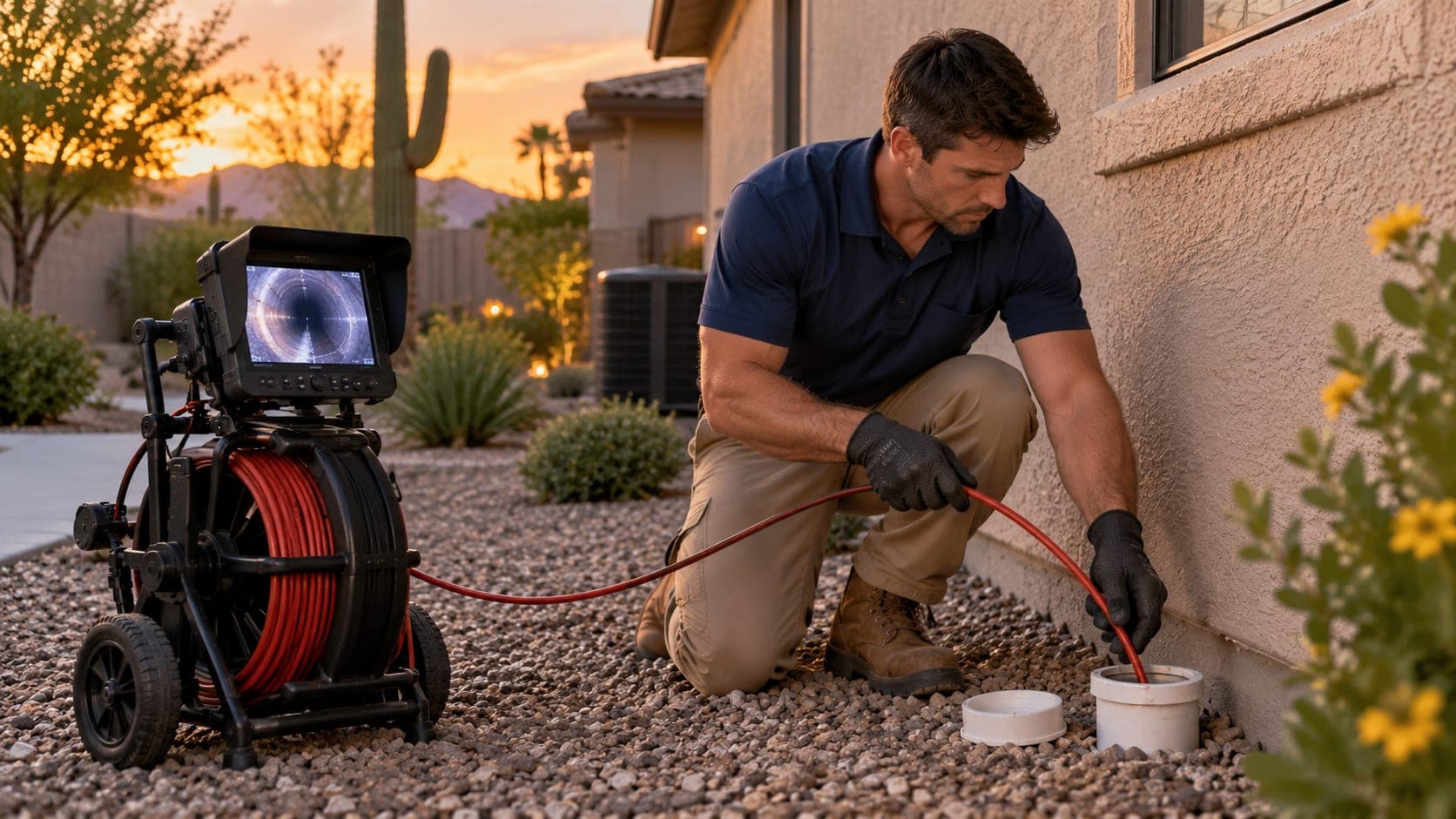
Roots do not attack sound pipe. They follow moisture. A clay or cast-iron lateral with a joint that has separated a fraction of an inch weeps a little water into the soil, the root follows it in, and once inside it grows into a mat that catches everything the house sends down. Cutting the roots buys a year. Finding the joint that let them in and having it lined or replaced ends it. A camera inspection shows both the root mass and the defect that admitted it, and a transmitter in the camera head lets us mark the spot on the lawn so the repair opens one hole under one tree, not a trench under three.
The Litchfield Park visit
- 1
Meter first
Everything closed, dial watched. Yard or house in two minutes.
- 2
Camera when the drains say so
In through the cleanout, out with video and a mark on the ground.
- 3
Pressure isolation on supply
Hot, cold, irrigation, pool. The gauge names the line.
- 4
Written report
Photos, video where used, position, depth, and a plumber we trust.
Litchfield Park leak detection questions
Will you have to cut my trees to fix the lateral?
We do not repair, but a precise mark means the plumber opens one small hole at the defect instead of trenching along the line. Lining, where the pipe allows it, avoids digging almost entirely.
My drains are slow every spring. Roots?
Almost certainly. Roots grow fastest when the trees leaf out. A camera shows the mass and the joint that admitted it.
Do you serve the newer subdivisions too?
Yes. The whole city, from the historic core to the subdivisions along Dysart and Camelback, plus the county pockets toward Goodyear and Avondale.