
Phoenix is not one city. It is a dozen cities that grew into each other and kept their plumbing. A Willo bungalow from 1928 still drains through clay. A 1970s ranch in Maryvale runs on galvanized steel that has been rusting from the inside for fifty years. An Ahwatukee two-story from 1995 has copper under the slab that the soil has been grinding against rebar ever since. An Arcadia teardown rebuilt last year is on PEX and will not trouble anyone for decades. Same water, same ground, five different failure stories. Knowing which house you are standing in is half the job.
Where Phoenix leaks, block by block
Central and the historic districts
Willo, Encanto, Coronado, F.Q. Story. Pier-and-beam here, slab there, and drain lines that predate the interstate. Sewer laterals and galvanized supply are the usual suspects.
Arcadia and Biltmore
Mid-century ranches, many remodeled, many with the original copper still under the floor. Hot-water slab leaks under kitchens and master baths are the signature call.
Ahwatukee and the foothills
Nineties subdivisions on hillside lots with pools on nearly every one. Pool plumbing and irrigation mains leaking into decomposed granite that never shows a puddle.
North Phoenix and Desert Ridge
Newer construction, longer service lines, and HOA irrigation that runs at night. When the bill jumps here, the yard is where we look first.
Maryvale, Alhambra, and the West Side
Post-war tract homes, dense and aging. Cast-iron drains at the end of their lives and galvanized supply that narrows to a straw before it fails.
Downtown, Midtown, and the corridors
Multifamily, restaurants, offices, and older commercial slab. Zone-by-zone pressure isolation after hours, so nobody closes early.
Why the ground under Phoenix works against you
The soil here is a patchwork. Along the river terraces it is sandy and drains; on the old farmland it is clay that swells in the monsoon and shrinks by May; in the foothills it is caliche, a natural cement that holds water against a pipe like a cupped hand. All three move. Copper does not stretch, and a fitting under a slab that has been tugged ten thousand times finally weeps. Add water hard enough to scale a coffee maker in a month and summers that push the attic past 140 degrees, and you have a city that manufactures leaks as a matter of routine.
Phoenix does not have a leak problem. It has a plumbing-age problem, and every neighborhood is a different age.
How a Phoenix locate goes
- 1
Meter first
Every Phoenix Water Services meter has a low-flow indicator. With the house closed, it tells us in two minutes whether the leak is in the yard or inside.
- 2
Isolate the system
Hot from cold, house from irrigation, pool from both. A gauge tells us which line is losing before anybody starts searching.
- 3
Listen and look
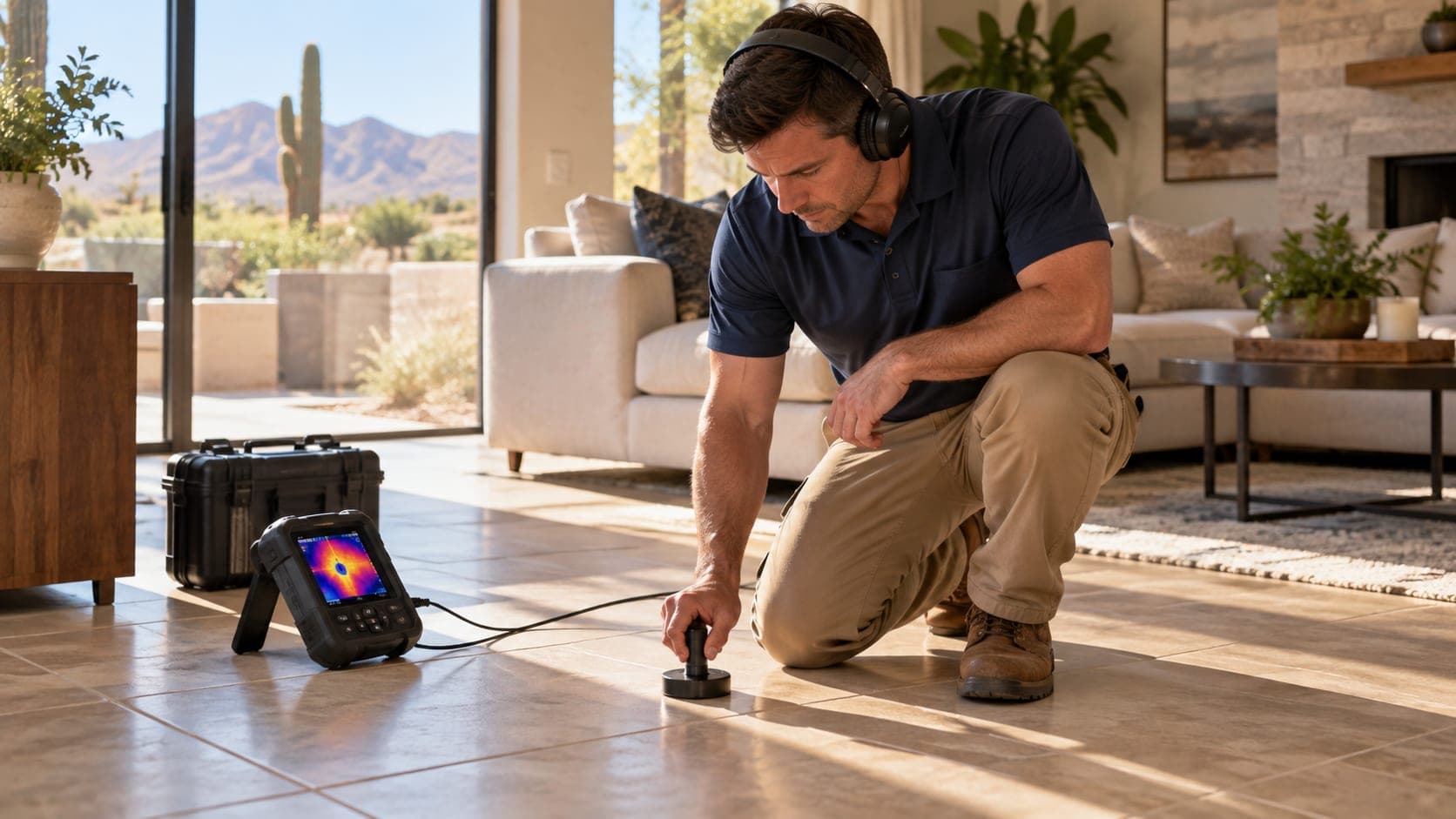
Acoustic sensors on the slab, thermal camera on the floors and walls. Phoenix tile carries sound beautifully; carpet pad does not, and we know where to lift a corner.
- 4
Mark and report
A mark on the floor or a flag in the yard, photos, the line and material involved, and a plumber we trust. Handed to you before the truck leaves.
What it costs to wait in Phoenix
Phoenix Water bills on tiers. A slab leak that runs a gallon an hour does not just add a gallon an hour to the bill; it can push the whole household into a higher rate. Then there is the floor. Tile over a wet slab pops. Wood swells. Drywall wicks. By the time a stain appears on a Phoenix baseboard, the leak has usually been running for weeks, and the repair has grown from a plumber's afternoon into a contractor's week. Finding it the day you suspect it is the cheapest thing you will do all year.
Phoenix leak detection questions
Do you serve all of Phoenix, or just certain zip codes?
All of it, from Anthem at the north edge to Ahwatukee and Laveen at the south, and from the Tolleson line east to the Scottsdale line. If you are inside the city limits, you are inside our route.
My house is on pier-and-beam in a historic district. Can you still find the leak?
Yes, and often faster. A crawl space means the pipe can be reached and listened to directly. Slab homes are the harder case, and we handle those daily too.
Is the leak my responsibility or the city's?
Phoenix Water is responsible up to and including the meter. Everything on the house side of the meter is yours. Our first test tells you which side the leak is on, and if it is the city's, we tell you and help you make the call.
How long does a Phoenix locate take?
Most homes take one to three hours. Older houses with several plumbing eras, or intermittent leaks, can take longer, and we say so before we start.