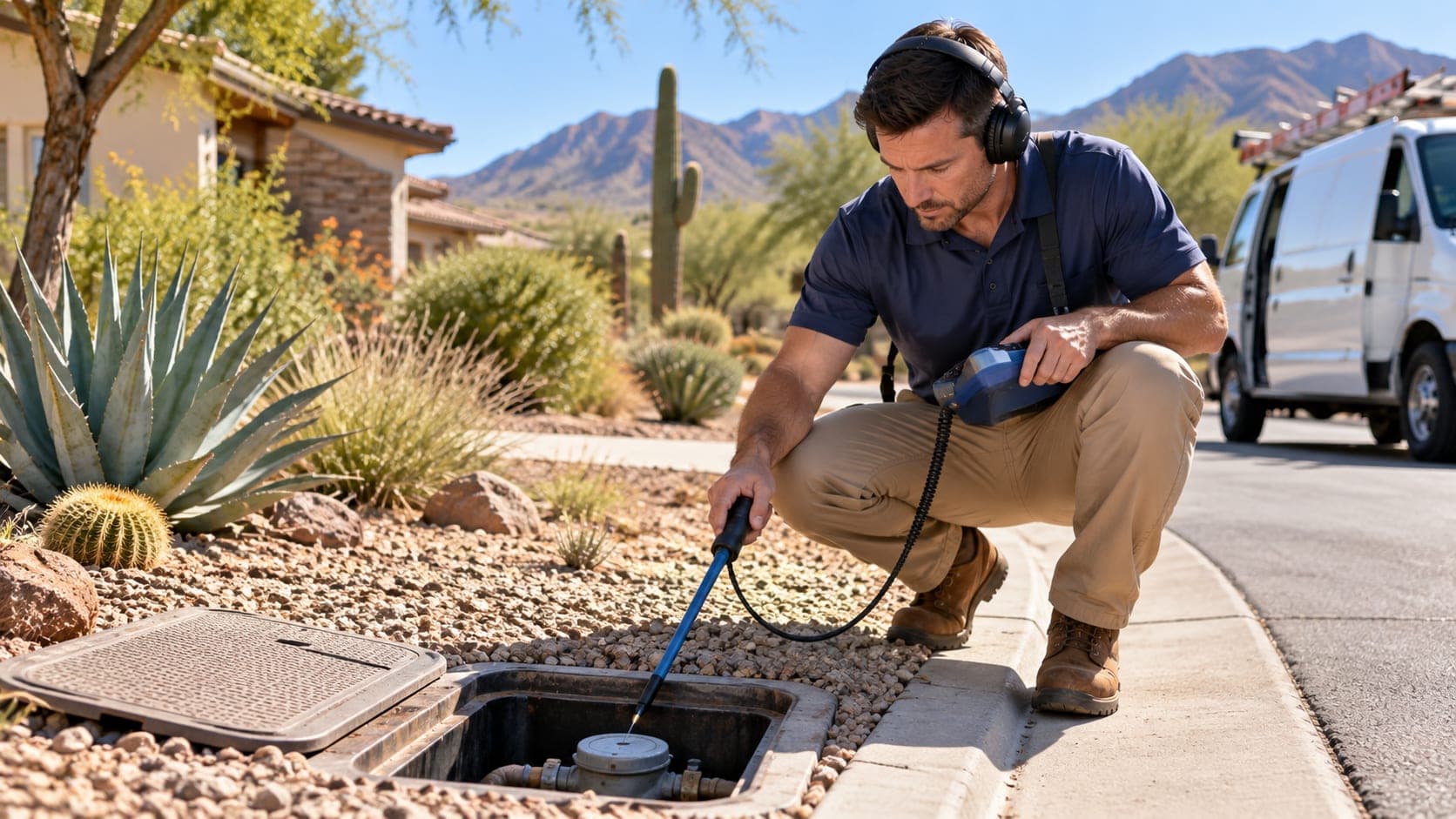
Every contractor in Arizona knows to call 811 before digging, and every contractor should. But there is a gap in that system large enough to drive a backhoe through. The public locate service marks lines owned by the utility companies, and those lines end at your meter or your property line. The water service to the house, the sewer lateral, the irrigation main, the conduit to the pool pump, the gas line to the barbecue island, the low-voltage run to the gate: all private, all unmarked, all waiting.
What private locating finds
Water service and irrigation
The main from the meter to the building, plus every landscape line branching off it. Metal or plastic, we trace both.
Sewer laterals and storm drains
From the building to the city tap, including cleanouts, bends, and the depth at each.
Electrical conduit
Feeds to outbuildings, pool equipment, gates, landscape lighting, and well pumps. The lines most often struck because nobody remembered them.
Private gas lines
Runs from the meter to grills, fire pits, pool heaters, and generators. The one you truly do not want to find with a shovel.
Low-voltage and communications
Security, data, and control cabling to gates, cameras, and irrigation controllers.
Septic systems and tanks
Tank lids, distribution boxes, and leach lines on properties beyond the sewer grid.
A locate costs a fraction of a struck line. It costs nothing at all compared to a struck gas line.
How we locate
- 1
Review what exists
As-built drawings, permits, and utility records, when they exist. They rarely match the ground, but they tell us where to start.
- 2
Electromagnetic locating
A transmitter puts a signal on a conductive line, either by direct connection or induction, and a receiver traces it across the surface. Metal pipes, tracer wire, cables, and conduit are all found this way, with depth readings.
- 3
Ground-penetrating radar
GPR sends radio pulses into the ground and reads the reflections. It finds what electromagnetic locating cannot: plastic pipe without tracer wire, clay sewer, tanks, and voids. It is the tool for the lines nobody documented.
- 4
Sonde and camera tracing
For sewer and drain lines, a transmitting sonde on a camera cable is pushed through the pipe and located from above at intervals.
- 5
Mark and map
Standard color-coded paint and flags on the ground, plus a sketch or overlay with depths and line types for the crew and the file.
Who calls us
- General contractors and excavators before trenching, grading, or footing work on residential and commercial sites.
- Pool builders before shooting a shell into a backyard threaded with irrigation and electrical.
- Landscapers installing trees, walls, and drainage in established yards.
- Property managers and facilities teams planning capital projects on aging campuses.
- Homeowners adding a casita, a fence, a pergola post, or anything else that goes into the ground more than a foot.
- Engineers and surveyors who need subsurface data for design.
Why locating and leak detection belong together
They are the same skills pointed at different questions. To find a main line leak, we first have to know where the main line runs. To locate a private utility, we use the same tracing and radar. A company that does both finds leaks faster, because it never has to guess where the pipe is, and locates utilities more completely, because it knows where water systems tend to hide. We do both on the same truck, often on the same visit.
Utility locating questions
Does Arizona 811 mark private lines?
No. The public locate marks utility-owned lines up to the service point, usually the meter. Everything on the property side is private and is not marked unless you hire a private locator.
Can you find plastic pipe?
Yes, with ground-penetrating radar or by tracing a sonde through the line. Electromagnetic locating alone cannot see plastic without tracer wire, which is why we carry both.
How accurate are the marks?
Horizontal position is typically within a few inches on a good electromagnetic trace. Depth readings are estimates and should be confirmed by careful hand digging near the mark, as every locating standard requires.
How far in advance should I schedule?
A few days is ideal. Same-day is often possible for small residential jobs. Large commercial sites are scoped and scheduled by phone.