
Every trade has a set of questions it answers a thousand times, and every trade develops a slightly glazed way of answering them. We have tried to avoid that here. What follows is what we would tell a neighbor over the fence: plain, specific, and honest about the parts that depend.
The basics
What is leak detection?
The process of confirming a plumbing system is losing water, identifying which line is losing it, and locating the exact point of escape, all without opening walls, floors, or ground to look. Instruments do the seeing and hearing; a trained technician does the interpreting. Longer answer here.
Why does it matter?
Three reasons. Water damage compounds daily and gets into structure and mold territory quickly. A leak runs up the bill every month it goes unfound. And in a desert valley, wasted water is a small civic failure as well as a private expense. Finding a leak early keeps all three small.
How do I know if I have a leak?
A bill that rose with no change in habits, the sound of water with everything off, a warm spot on the floor, stains or damp spots, a musty smell, low pressure everywhere, or a green patch in the yard. The most reliable check is the meter test: everything off, watch the low-flow indicator for two minutes. If it moves, water is going somewhere. All seven signs here.
Do I really need a professional?
If you can see the leak, probably not. If you cannot, the alternative to instruments is guessing, and guessing in a house means holes. A professional locate replaces the holes with a mark. How to decide.
The visit
What equipment do you use?
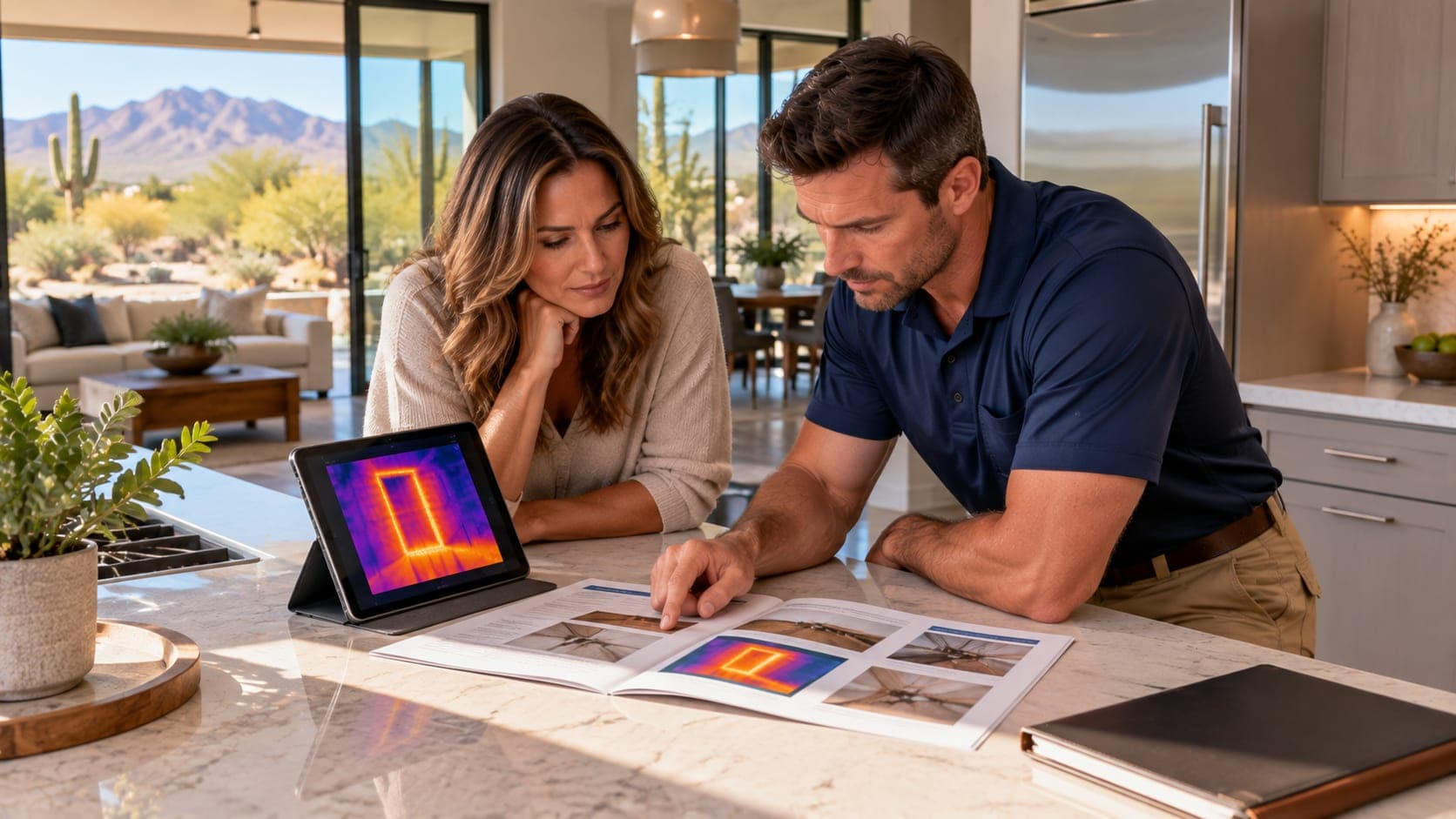
Acoustic ground microphones and leak correlators to hear pressurized water through concrete and soil. Infrared thermal cameras to see the temperature trail water leaves in floors and walls. Pressure gauges to isolate systems and confirm which line is losing. Electromagnetic locators and ground-penetrating radar to map where pipes run. Sewer cameras with locating sondes for drain lines. Moisture meters and dye to confirm. We bring all of it and use what the leak calls for.
Is it non-invasive? Will you damage anything?
Yes, and no. Detection is done from the outside of surfaces. The only opening happens during the repair, at the spot we marked, and it is one small opening instead of several exploratory ones.
How long does it take?
Most homes take one to three hours. Commercial buildings, large properties, and intermittent leaks take longer, and we tell you when a job is heading that way rather than surprising you.
How should I prepare?
Make sure we can reach the water meter, the main shutoff, the water heater, and any room where you have seen water. Turn off sprinklers and pool autofill. Move anything fragile out of suspect areas. Have your last two water bills handy. If you can, quiet the house: ice makers and appliances on cycles make acoustic work harder.
Do you repair the leak?
No. We locate and document. Repairs are done by licensed plumbers, and we refer ones we trust. Keeping detection separate from repair means our findings are never shaped by what we would like to sell you next.
What if you cannot find it?
Rare, but honest companies admit it happens, usually with intermittent leaks that only run under certain conditions. We tell you what we ruled out, what we still suspect, and what it would take to confirm. We do not invent a finding to justify the visit.
Money
How much does leak detection cost?
It depends on the property, the number of systems to test, and how coy the leak is being, so we quote by scope on the phone rather than publishing a number that would be wrong half the time. What we can promise is that the quote comes before the truck does, and that finding a leak costs a great deal less than not finding it.
Is leak detection covered by insurance?
Often partially. Many homeowner policies cover sudden water damage and the cost of accessing the leak, while excluding the pipe repair itself. Policies vary widely. Our written report with photos is built to support a claim. Call your agent before the repair, not after, and keep every receipt.
Does same-day or emergency service cost more?
Same-day is our normal schedule and is priced normally. After-hours emergency calls are priced as emergencies, and we tell you the number before we roll.
Specific situations
How do I know if the leak is inside or outside the house?
Close the main shutoff valve at the house and watch the meter. Still turning? The leak is in the buried line between meter and house. Stopped? It is inside. This is the first test we run, and it is one you can do yourself.
Can you find a slab leak without breaking the floor?
Yes. Acoustic listening, thermal imaging, and pressure isolation locate it from above. The plumber opens one small area at our mark for the repair. Slab leaks in detail.
Can you find a pool leak?
Yes. Pools leak through the shell, the plumbing, or the equipment, and each needs a different test. We do all three and tell you which one it is.
Can you find a sewer line leak?
Yes, with a camera in the line and a locating transmitter that lets us mark its position and depth from the surface. Smoke and dye testing confirm where needed. Sewer lines in detail.
Do you locate utilities before digging?
Yes. Arizona 811 marks public lines to the meter; we map everything past it: water, sewer, irrigation, electrical, gas, and low-voltage. Private utility locating.
How often should I have leak detection done?
For most homes, run the meter test monthly and call when it moves. Older homes with original copper, properties with pools and large irrigation systems, and commercial buildings benefit from a scheduled survey, typically once a year, because a leak found on a calendar is cheaper than one found in a tenant's email.