
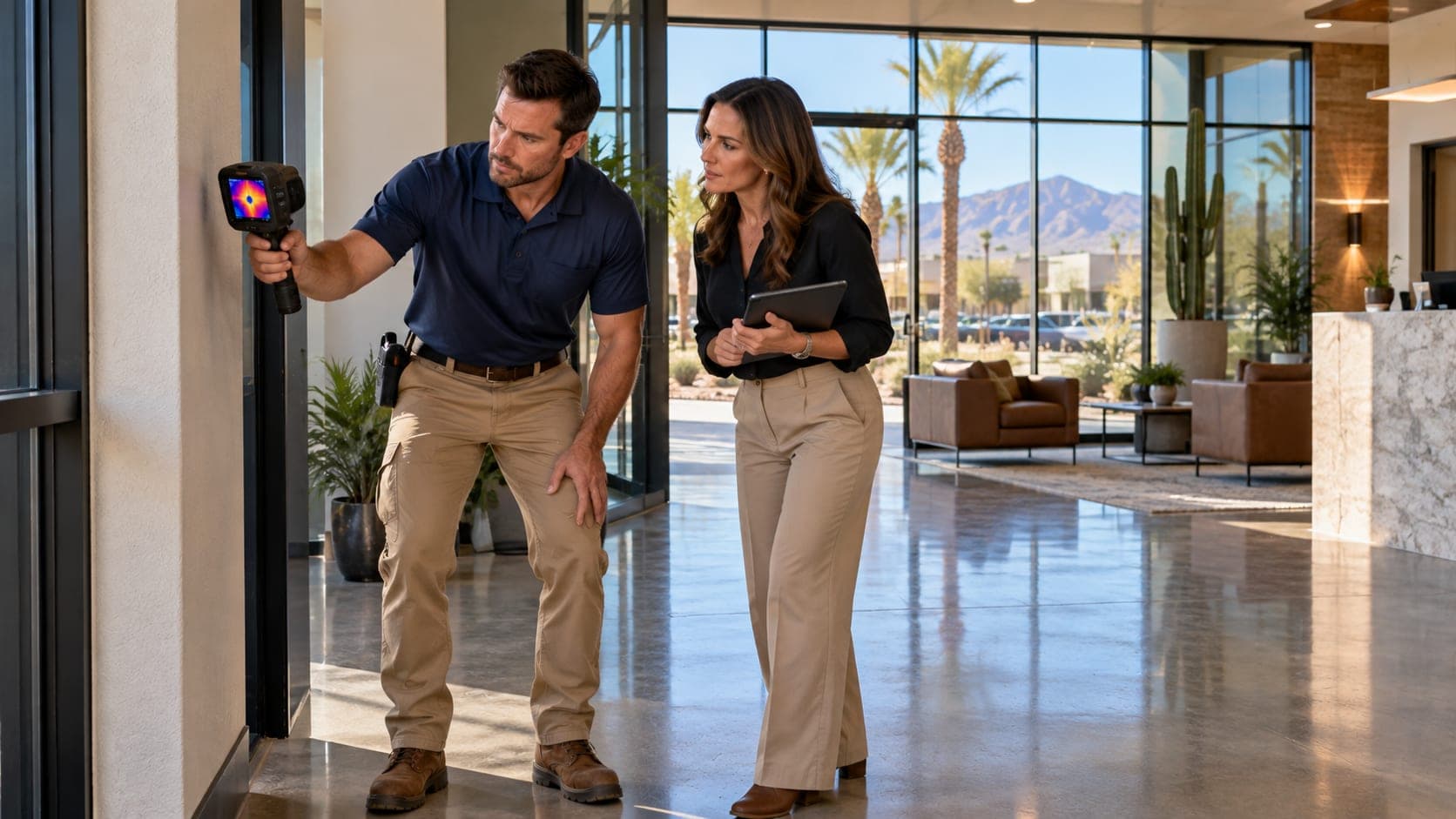
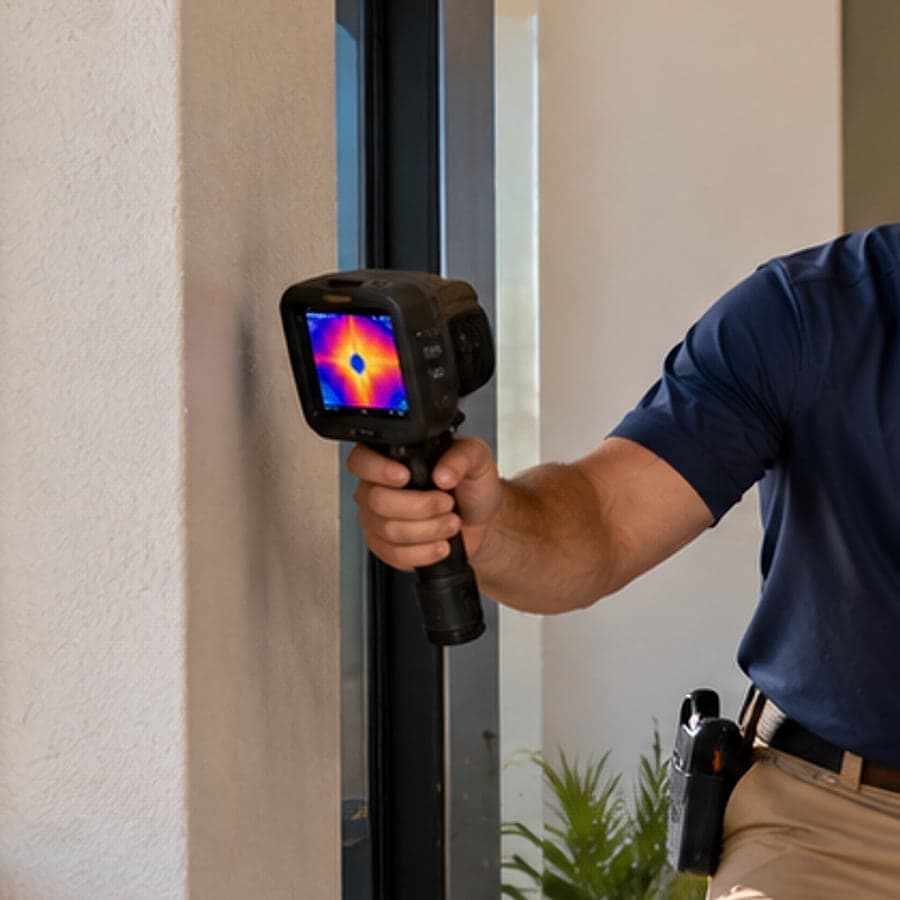
Everything warmer than absolute zero radiates infrared light, and everything in your house is warmer than absolute zero, even in January. A thermal camera photographs that light and paints it in false color: warm areas glow, cool areas darken. Water changes temperature differently than drywall, tile, or concrete. So where water has gone, the picture changes. A wet spot behind an intact wall shows up as a cool shadow. A hot line leaking under a slab shows up as a warm bloom on the floor. The camera does not see water. It sees what water does.
How we use it
Thermal imaging is a survey tool. It answers the question “where should we look?” faster than any other instrument we own. A technician sweeps floors, walls, and ceilings and watches for patterns that do not belong: a plume spreading from a point, a cool band where moisture is wicking, a warm line tracing a hot-water pipe that should not be warm because the heater has been off for an hour. Each anomaly becomes a candidate. We then confirm the candidate with a moisture meter, acoustic listening, or pressure isolation, because a thermal picture alone can lie. Sunlight through a window, a duct in the wall, a warm appliance: all leave signatures. Reading them correctly is the skill.
The camera does not see water. It sees what water does. Knowing the difference is the whole job.
Where thermal imaging shines
Hot-water slab leaks
The signature use. The leak heats the concrete above it, and the warm plume shows on the floor. Often the fastest way to shrink the search from a house to a square foot.
Leaks inside walls and ceilings
Moisture wicking through drywall cools it by evaporation. The cool patch appears before the stain does, sometimes weeks before.
Roof and monsoon leaks
Water travels along decking and insulation before it drips. The camera traces the wet path back to the entry point, not just the ceiling stain.
Shower pans and tile
Failed pans and grout let water into the subfloor. Thermal shows the saturated area behind an intact-looking surface.
Commercial roofs and mechanical rooms
Large areas surveyed quickly. Wet insulation on a flat roof holds heat after sunset and lights up the camera.
HVAC condensate lines
A clogged or cracked condensate drain wets the ceiling under an air handler. Thermal finds the wet area; the meter confirms it.
Why non-invasive matters more in Phoenix
Phoenix homes are mostly slab-on-grade with tile floors and stucco walls. Every one of those surfaces is expensive to open and unpleasant to close. The old method of finding a wall leak was to open the wall and see. Thermal imaging lets us see first and open only where the repair belongs. It reduces the demolition to one small hole in the right place, and it keeps the search out of the rooms that were never involved.
What the camera cannot do alone
It cannot see through walls. It sees the surface temperature of the wall, which moisture behind the surface changes. It cannot see a leak that has not yet changed the temperature of anything, which is why very fresh or very slow leaks sometimes need an acoustic pass first. And it cannot tell the difference between a leak and a cold draft from an unsealed outlet without a technician who has seen both a few hundred times. Thermal is one instrument in a kit. We bring the kit.
Thermal imaging questions
Can thermal imaging see through walls?
No. It sees the surface temperature of the wall. Moisture behind the surface changes that temperature, which is what we read. The distinction matters because it is why we confirm every thermal finding with a second method.
Does it work on cold-water leaks?
Yes, differently. Cold-water leaks and evaporation cool the surrounding material, so we look for cool patterns instead of warm ones. Hot-water leaks are simply easier because the contrast is larger.
Is it safe?
Entirely. A thermal camera is a passive receiver. It emits nothing. It is the same technology used in home energy audits and building inspections.
Do I get the thermal images?
Yes. Our report includes the infrared images alongside standard photos so you, your plumber, and your insurer can see exactly what we saw.