
Queen Creek kept its country longer than its neighbors, and much of it still shows: irrigated pastures, horse properties on an acre or more, a main street with a feed store's worth of history. Then the subdivisions arrived along Ellsworth and Ocotillo and Rittenhouse, and the town added tens of thousands of people in a decade. So Queen Creek now has two plumbing lives. The larger lots have long service lines, private irrigation mains, hose bibs at the barn, and sometimes a well. The new subdivisions have short runs of modern pipe and the usual new-construction surprises. On both, the distance between the water source and the house is the thing that makes a leak hard to find, and the thing we solve first.
Where Queen Creek leaks
Long service lines on acre lots
Meter at the road, house far back, line run decades ago by whoever owned the place. We trace the actual route and depth, then correlate to the break.
Pasture and private irrigation
Flood irrigation gates, buried mains to the arena, bubblers to the trees. A cracked fitting under gravel runs for a season on the bill.
Wells and pressure tanks
No city meter to watch. We isolate at the tank and use the gauge and pump cycling as the witness, then locate the same way.
New subdivisions
Construction-damaged service lines and hurried fittings. Warranty-ready reports for the builder.
Pools on the new lots
Skimmer, return, and spa lines under decks, tested one at a time.
Septic on the older parcels
Not every Queen Creek lot is on sewer. We locate tanks and leach lines before anyone digs near them, and we camera the house drain to the tank.
On an acre, a leak does not have to be clever to hide. It only has to be quiet.
Why we trace before we listen
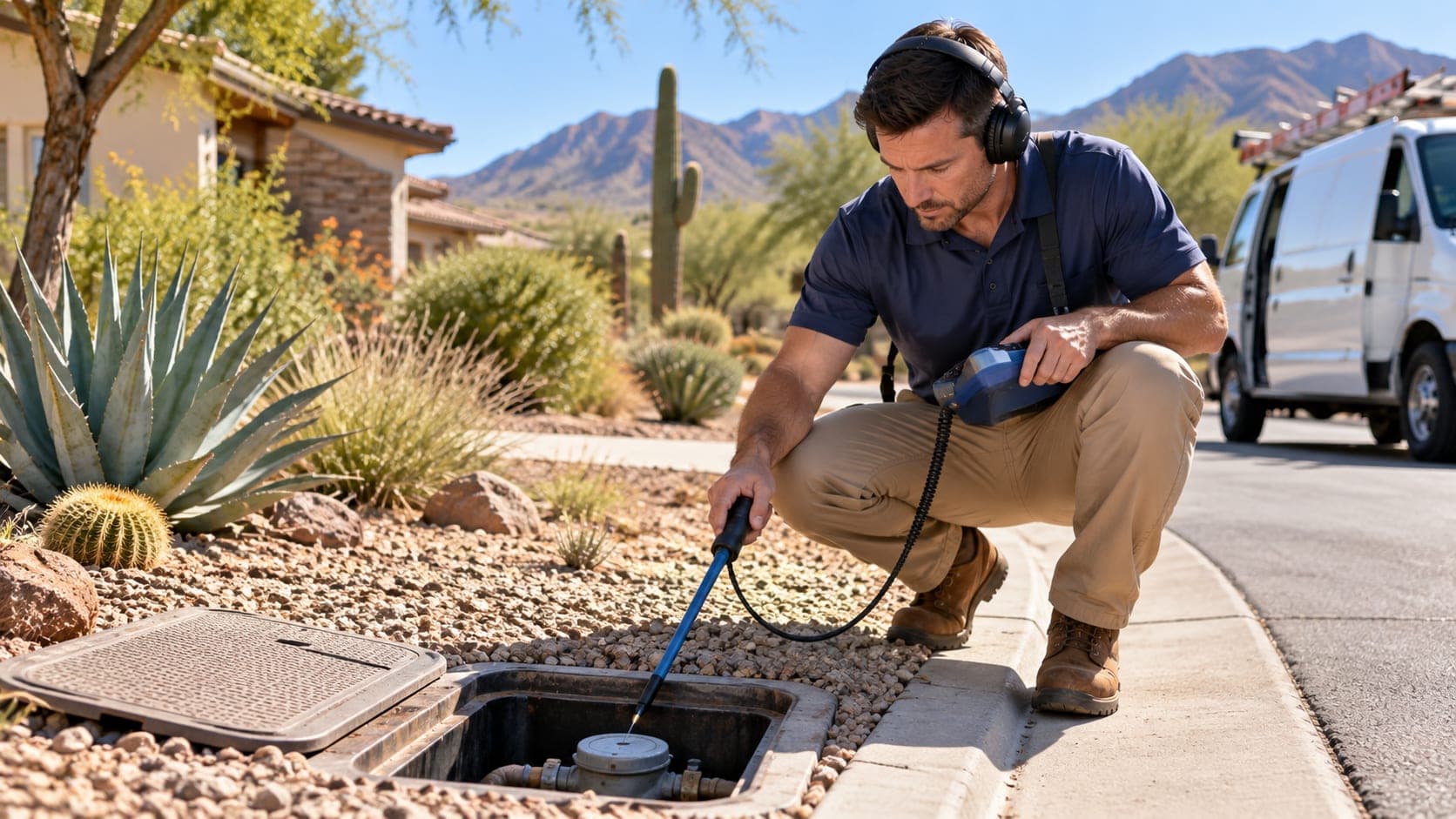
Listening for a leak works only if you are standing over the pipe. On a quarter-acre subdivision lot, the pipe is where you would guess. On a Queen Creek horse property, it may run diagonally under the arena because that was the shortest trench thirty years ago, and there is no drawing anywhere. So we put a signal on the line and walk it with a receiver, marking the route and depth as we go. Only then do we listen, and only along the marked strip. It turns an afternoon of guessing into an hour of knowing.
The Queen Creek visit
- 1
Meter or tank check
Town of Queen Creek meters carry a low-flow indicator. On a well, the pressure tank's gauge and pump cycle stand in for it.
- 2
Trace the line
Electromagnetic locating and, for plastic without tracer wire, ground-penetrating radar. The route and depth go on the ground in paint.
- 3
Correlate
Two sensors on the traced line. The math finds the leak under gravel, arena sand, or driveway.
- 4
Report with a sketch
Route, depth, position, photos, and a plumber we trust.
Queen Creek leak detection questions
I am on a well. Can you still find a leak?
Yes. We isolate at the pressure tank and use its gauge and the pump's cycling as the witness in place of a meter, then trace and correlate exactly as we would on city water.
Nobody knows where the line runs on my property. Is that a problem?
It is the normal case on larger lots, and it is why we trace first. A transmitter on the line and a receiver walked across the ground map the route and depth before we listen.
Do you serve San Tan Valley?
Yes. San Tan Valley, the Pinal County side of Queen Creek, and the parcels toward Florence Junction are on the route.