
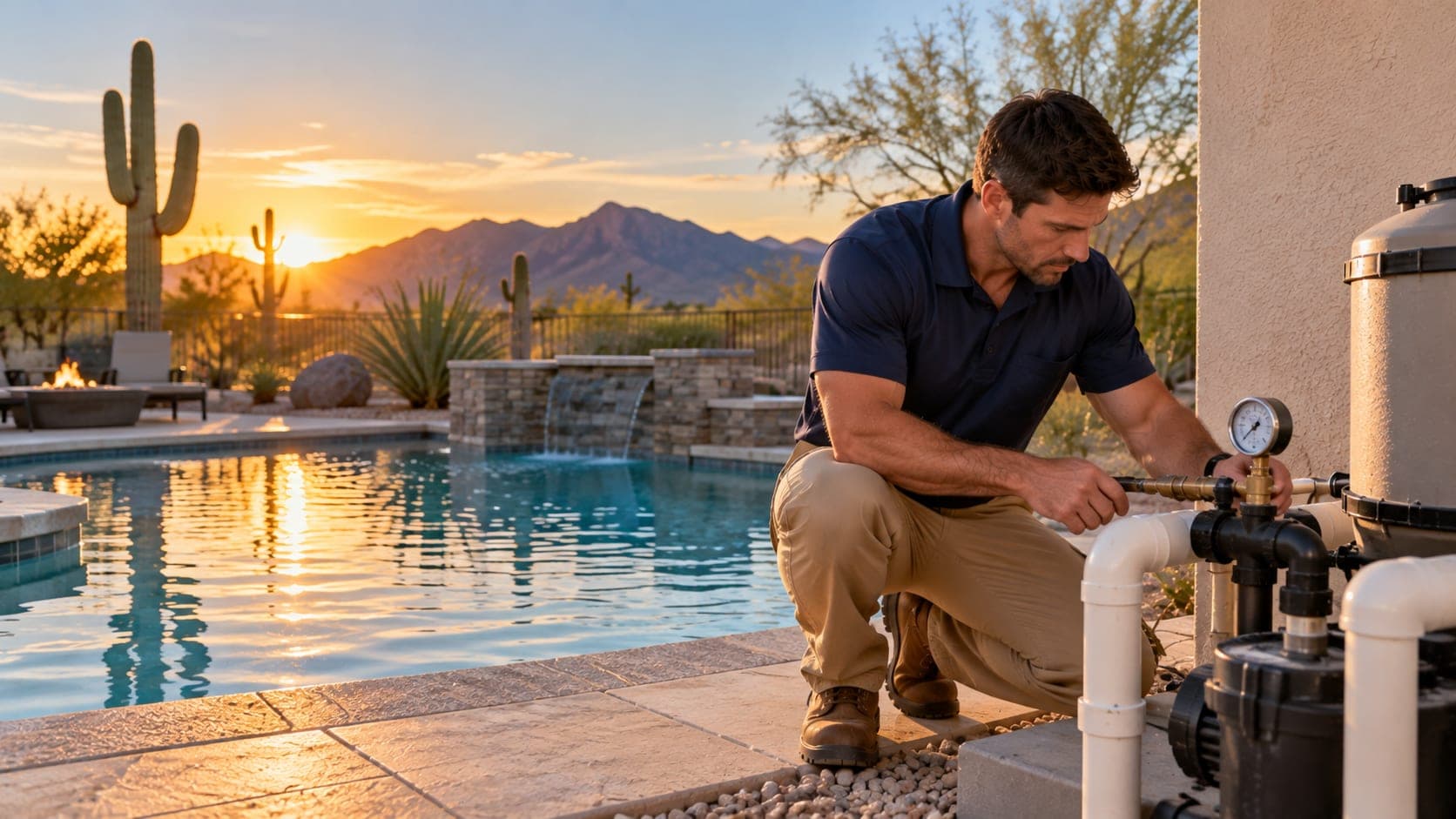
There is a temptation, when a homeowner says “I think there is a leak somewhere,” to begin looking at once. It is the wrong instinct. A house has several separate plumbing systems: hot supply, cold supply, irrigation, pool, sometimes gas. Each can be isolated with a valve and watched with a gauge. Fifteen minutes with a gauge tells us which system is losing, and often which half of it. The search that follows is a quarter the size. That is the difference between a locate that takes an hour and one that takes an afternoon.
How a pressure test works
- 1
Isolate the system
We close the main and any zone valves so the line under test is sealed from the supply and from other systems.
- 2
Pressurize
The line is brought to a known pressure. For potable lines, that is usually the house's normal pressure or a little above. For irrigation and pool plumbing, we use air or water as the line allows.
- 3
Watch the gauge
A sealed line with no leak holds steady. A leaking line drops. The rate of the drop tells us how large the leak is, and comparing hot and cold sides tells us which side has it.
- 4
Narrow by zone
Where a system has branches, such as irrigation zones or pool return lines, each branch is tested separately. The failing branch becomes the search area.
- 5
Hand off to the locators
With the system and branch identified, acoustic listening and thermal imaging find the exact spot within it.
A gauge cannot be argued with. It either holds or it does not. Everything we do afterward is built on that answer.
What we pressure test
Hot and cold potable lines
Isolated separately. A hot-side drop points at the water heater loop and slab runs. A cold-side drop points at the main and the fixtures.
Main water service line
The house is closed off at its shutoff and the buried line watched at the meter. If it drops, the leak is in the yard. Details here.
Irrigation mains and zones
Landscape lines are pressurized zone by zone. A zone that will not hold is a zone with a leak, and the search is confined to it.
Pool and spa plumbing
Suction, return, and equipment lines are plugged and tested one at a time. This separates a plumbing leak from a shell leak, which are repaired very differently.
Sewer and drain lines
Hydrostatic testing fills a drain line and watches the level. A drop confirms a leak that a camera then locates. Sewer detail here.
Commercial systems
Multi-zone buildings, hydronic loops, and fire lines tested by zone during off-hours to avoid downtime.
Why the test comes first
Two reasons, and both save you money. First, it confirms there is a leak at all. A surprising share of “leaks” turn out to be a running toilet, a sprinkler timer, or a meter error, and a pressure test finds those in minutes rather than hours. Second, it shrinks the search. Instruments like acoustic sensors are precise but slow; they work best when they have a small area to work in. The gauge gives them that area. It is the least glamorous tool we own and the one we would give up last.
What a pressure test cannot tell you
It tells you that a line is leaking and roughly how badly. It does not tell you where. That is why it is a first step, not a last one. A test also requires the line to be isolatable, and some older homes have valves that no longer close fully. When that happens, we say so and adapt, rather than reporting a result the plumbing did not actually give us.
Pressure testing questions
Will the water be off during the test?
Briefly. Isolating a line means closing valves for the length of the test, usually fifteen to thirty minutes per system. We tell you before we close anything and restore it when we are done.
Can pressure testing damage my pipes?
Not when done correctly. We test at or modestly above normal operating pressure, never at levels that stress sound pipe. A line that fails at normal pressure was already failing.
How do you test a pool without draining it?
The plumbing lines are plugged at the pool and pressurized from the equipment pad. The shell stays full. A separate dye or bucket test evaluates the shell itself.
Is a pressure test enough to find the leak?
No, and anyone who claims otherwise is guessing. It confirms and narrows. Acoustic and thermal methods then locate the exact spot.